Capturing breathtaking, dynamic footage that truly immerses your audience often requires moving the camera in ways a handheld approach simply cannot. Whether you’re aiming for a high-octane car chase sequence or a dramatic, sweeping crane shot, integrating a camera gimbal with specialized rigs like car mounts or jib arms unlocks unparalleled creative potential. This combination allows filmmakers to achieve buttery-smooth, cinematic movements that elevate production value. However, mastering these advanced setups demands a thorough understanding of the equipment, rigorous safety protocols, and refined operational techniques. This comprehensive guide will walk you through everything you need to know to confidently use a gimbal on a car mount or jib arm, transforming your vision into stunning reality.
What is a Camera Stabilizer? Why You Need One for Car Mounts and Jib Arms
A Camera Stabilizer, particularly a gimbal, is an indispensable tool designed to keep your camera level and steady, compensating for unwanted movements such as shakes, tilts, and pans. Modern gimbals use motors and sophisticated algorithms across multiple axes (typically three) to counteract any motion, ensuring your footage remains incredibly fluid. While often used handheld, their true power extends to more complex rigging scenarios.
On a car mount, a gimbal absorbs the constant jostling and minor vibrations inherent in vehicle movement, delivering a professional, stable perspective of the action. Without a gimbal, even the most robust car mount would transmit every bump and tremor, resulting in shaky, unusable footage. Similarly, when paired with a jib arm, a gimbal allows for expansive, soaring, or descending camera movements without introducing any jarring motion. This synergy enables filmmakers to execute complex, multi-axis shots that are virtually impossible with either tool used in isolation, creating dynamic and visually appealing content that captivates viewers.
Essential Factors for Choosing a Camera Stabilizer Setup
Selecting the right stabilizer setup for your car mount or jib arm depends on several critical factors, each influencing the compatibility, performance, and overall success of your shoot. Consider these elements carefully to ensure your gear meets your specific project needs.
Camera Type and Weight
The camera you plan to use is paramount when choosing a gimbal and its corresponding mount. Gimbals are designed with specific payload capacities, ranging from lightweight models for smartphones and action cameras to heavy-duty units for professional cinema cameras. Always ensure your gimbal can comfortably support the combined weight of your camera, lens, and any accessories (like external monitors or wireless transmitters). Exceeding this limit will compromise stabilization performance and could damage your equipment. For car mounts, the mount itself must also be rated for the total weight of the camera, gimbal, and any additional rigging components, including safety redundancies.
Budget Considerations
Filmmaking equipment spans a wide range of price points, and car mounts and jib arms are no exception. Entry-level solutions, often utilizing consumer-grade suction cups and monopods, can be surprisingly effective for smaller cameras and controlled environments. Mid-range options offer improved stability, greater load capacities, and more versatile mounting points, often suitable for indie film productions or dedicated vloggers. Professional-grade systems, like advanced vibration-isolating car rigs or large studio jibs, represent a significant investment but provide unparalleled stability, reliability, and precision for high-end cinematic projects. Balancing your budget with your performance requirements is key.
Purpose of Use
Your intended application heavily influences the type of setup you’ll need. Are you shooting fast-paced action sequences, requiring extreme durability and vibration isolation on a car? Or are you aiming for elegant, flowing reveal shots using a jib arm in a studio or on location? For vehicle shots, dynamic movements might necessitate multi-point suction cup systems combined with a vibration-isolating arm to dampen road shock. For jib shots, the length and reach of the arm will dictate the scale of your crane movements, while the gimbal ensures the horizon remains level throughout the arc. Understanding your creative goals will guide you toward the most appropriate rigging solution.
Portability and Rigging Complexity
Consider the practicalities of transport, setup, and teardown. A compact, easily deployable car mount might be ideal for run-and-gun documentary work, whereas a complex car rigging system designed for maximum stability will require more time and personnel for assembly. Similarly, mini-jibs are lightweight and simple to operate, often pairing well with handheld gimbals on monopods for quick, versatile crane-like shots. Larger jibs, while offering extensive reach, demand dedicated counterweights, robust tripods, and a more involved setup process. Assess whether your project schedule, crew size, and location constraints favor portability or comprehensive rigging complexity.
Mastering Gimbal Use on Car Mounts
Shooting from a moving vehicle offers unique perspectives, but achieving professional-grade stability is a meticulous process. Integrating a gimbal with a car mount requires careful planning, secure rigging, and a strong understanding of vibration management.
Selecting and Securing Your Car Mount
The foundation of any successful car-mounted shot is a robust and properly installed rig. Suction cup mounts are a popular choice, available in various sizes, with 10-inch cups offering the strongest hold. These work best on flat, clean vehicle surfaces like hoods, roofs, or doors. For maximum security, always use multiple suction points. Some setups even utilize a trailer hitch adapter to create stable mounting points at the rear of SUVs or trucks.
Safety is paramount. Beyond the primary mounting points, it’s critical to employ redundancy. Always use safety tethers, ratchet straps, or safety cables to secure your camera and gimbal to secondary points on the vehicle [cite: 1, 3 (Car Mounting Safety, Keeping Your DJI Ronin RS2 From Falling)]. Before attaching any gear, thoroughly clean the vehicle surface to ensure optimal suction. Regularly inspect suction cups and all mounting hardware for wear or damage, testing each cup’s vacuum seal before every use to prevent unexpected detachment [cite: 2 (Car Mounts and Suction Rigs)].
Battling Vibrations and Achieving Stability
While gimbals excel at stabilizing rotational movements, they may struggle with direct bumps and micro-vibrations transmitted through the car’s chassis. These subtle shakes, often caused by road conditions or engine vibrations, can introduce undesirable “jello” effects or micro-jitters in your footage. This is where specialized vibration isolators or dampening arms become essential.
These isolators act as a shock absorber between the car mount and the gimbal, effectively decoupling the camera system from the vehicle’s direct vibrations. By adding a spring arm or a similar dampening system, you can significantly reduce the impact of road imperfections, allowing your gimbal to focus on fine-tuning stabilization. Positioning your camera and gimbal as close to the car’s surface as possible can also help, minimizing the leverage that might amplify vibrations and create a pendulum effect [cite: 4 (About to give up on these car mount shots)].
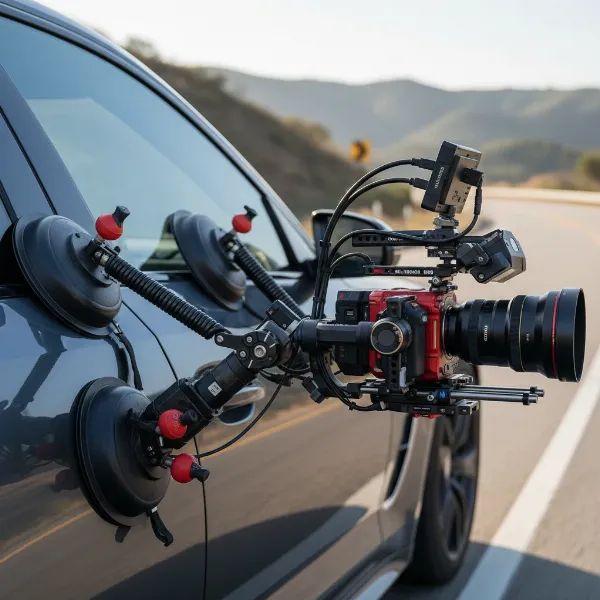 Professional car mount with a gimbal, camera, and vibration isolator for stable vehicle shots.
Operational Best Practices for Car Shots
Once your gimbal is securely mounted and balanced on the car, operating it effectively requires a coordinated approach.
“Safety is always on my mind, especially when doing any overhead rigging or vehicle rigging.” – Brendan Riel, Owner of Legacy Grip [cite: 1 (How To Build a DIY Car Camera Rig)]
- Gimbal Balancing: Prior to any shoot, perform a meticulous static balance of your camera and lens on the gimbal. This reduces the strain on the gimbal motors and maximizes their performance.
- Remote Control and Monitoring: For most car-mounted shots, you’ll operate the gimbal remotely from within the vehicle. Utilize a wireless video transmitter and an external monitor to accurately frame and control your shots while the car is in motion.
- Route Planning and Spotters: Plan your driving route carefully, considering road conditions and potential obstacles. Always use a dedicated spotter in the vehicle to monitor traffic and ensure safety, allowing the driver to focus solely on driving [cite: 3 (Build Your Own Car Rig)].
- Shooting Techniques:
- High Frame Rates: Shooting at higher frame rates (e.g., 60fps or 120fps) provides more flexibility in post-production for smooth slow-motion effects, which can further mask any minor jitters.
- Wide-Angle Lenses: Wide-angle lenses are often preferred for car-mounted shots as they enhance the sense of speed and minimize the appearance of minor movements.
- Focus Management: Depending on your setup, consider using a wireless follow focus system for precise control over your depth of field.
Elevating Cinematography with Gimbals on Jib Arms
Jib arms, also known as camera cranes, allow for sweeping vertical and horizontal camera movements that add a sophisticated, dynamic feel to your footage. Combining a jib with a gimbal elevates these movements to an unprecedented level of smoothness and precision.
Integrating Gimbal and Jib Arm
Mounting a gimbal onto a jib arm allows the camera to maintain perfect horizon leveling and smooth pan/tilt control even as the jib itself moves through a complex arc. This combination effectively creates a highly advanced, remote-controlled crane system. For lighter cameras, a handheld gimbal mounted on a monopod can even simulate mini-jib or crane shots, offering a portable and affordable alternative for dynamic movements [cite: 3 (Gimbal + Monopod = Cinematic Crane Shots!)]. The key is to securely attach the gimbal to the jib’s camera plate, ensuring it’s balanced according to both the gimbal’s and the jib’s specifications.
Executing Dynamic Jib Movements
The true artistry of using a gimbal on a jib arm lies in the execution of fluid, controlled movements. Jibs are ideal for “crane” shots, where the camera smoothly ascends or descends. They also excel at “sweep” shots, moving horizontally across a scene, and “reveal” shots, where the camera starts behind an object and then glides to reveal the subject. When operating a jib, especially a manual one, using two hands to grip different points on the arm helps dampen unwanted movement [cite: 2 (Tips for Working with Camera Jibs)]. Maintaining a stable stance, bending your legs, and tucking in your elbows can further enhance smoothness and extend your range of motion, allowing for grander, more impactful shots [cite: 1 (How to do the Crane Jib Shot)]. For certain jib movements, particularly those focusing on a specific subject while the jib moves, engaging the gimbal’s “locked-off” or “full-follow” modes can be beneficial. In locked-off mode, the gimbal holds its position relative to the horizon, ensuring consistent framing as the jib moves. In full-follow, it will smoothly track your pan and tilt inputs, even as the arm moves. Experiment with these modes to find what works best for your desired shot [cite: 3 (Gimbal + Monopod = Cinematic Crane Shots!)].
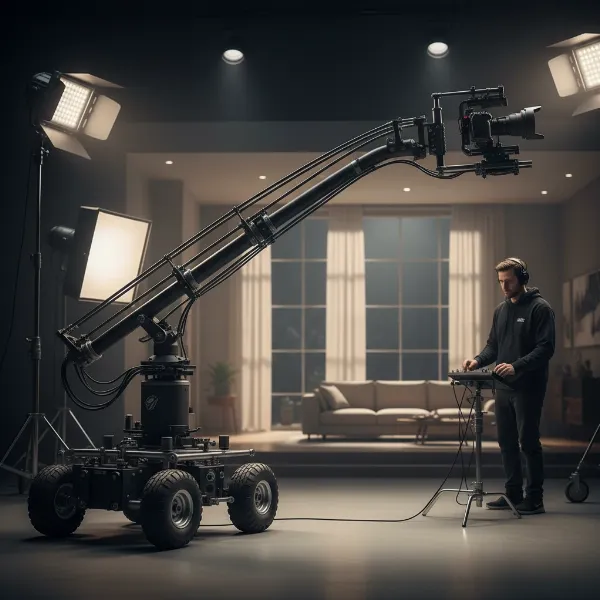 Camera on a jib arm with a gimbal, performing a smooth cinematic crane shot on a film set.
Creative Composition and Control
The expansive movement capabilities of a jib with a gimbal open up a world of creative compositional choices.
- Wide-Angle Lenses and Foreground Elements: Employing wide-angle lenses helps to exaggerate the sense of motion and scale. Strategically incorporating foreground objects into your shot as the jib moves past them creates a powerful parallax effect, adding depth and visual interest [cite: 4 (7 Tips for Working with a Mini-Jib)]. Get closer to these elements than you might initially think, making the movement more dramatic.
- External Monitors for Precise Framing: While some cameras have articulating screens, an external monitor is highly recommended for precise framing and composition when operating a jib. This allows the operator to clearly see the shot from a comfortable distance, especially during extreme high or low angle movements.
- Smooth Transitions and Pacing: Practice makes perfect. Start with simple, slow movements before attempting complex, multi-directional shots. Focus on smooth starts and stops, and integrate the jib’s movement with the pacing of your scene. Remember, less can often be more; a few well-executed, impactful jib shots are far more effective than many poorly performed ones.
Top Gear Recommendations for Car Mounts and Jib Arms
The market offers a diverse array of equipment to facilitate gimbal use on car mounts and jib arms. Here are some categories and examples to consider for your next production.
Professional Car Mounting Systems
These systems are designed for serious filmmaking, offering maximum stability and vibration control.
- Tilta Hydra Alien Car Mounting System: Known for its robust suction cups, shock-absorbing arm, and adaptability for various gimbals like the DJI RS 2/3 Pro, providing stable and dynamic car-mounted shots.
- Proaim SuperGrip Vibration Isolator Suction Car Mount: Features multiple suction cups, vibration isolators, shock modules, and tension cables to drastically reduce shake, capable of handling significant payloads.
- Flowcine Black Arm: A high-end professional system specifically designed for camera stabilization on moving vehicles, often used with larger gimbals.
Versatile Jib Arms for Gimbal Integration
These jibs are well-suited for mounting gimbals, enhancing smooth cinematic movements.
- Kessler Crane Stealth / Pocket Jib Traveler: Offers lightweight, portable solutions with smooth operation, ideal for integrating smaller to mid-sized gimbals.
- ProAm USA Orion Jibs: A range of mini-jibs that provide excellent reach and smooth motion, perfect for adding a gimbal for enhanced stability and control.
- DIY Gimbal + Monopod Setups: For budget-conscious filmmakers, combining a handheld gimbal (like DJI RS series or Zhiyun Weebill/Crane series) with a sturdy monopod can effectively mimic jib movements for crane-like shots.
Essential Safety Accessories
Never compromise on safety when rigging cameras to vehicles or using large jib arms.
- Ratchet Straps and Safety Cables: Crucial for providing redundancy when using suction cup mounts, securing the entire rig to additional points on the vehicle.
- Dedicated Gimbal Safety Plates/Rings: Smallrig offers specific mounting plates for popular gimbals like the DJI Ronin series, allowing for easy attachment of safety cables to the gimbal itself.
- Surface Cleaning Kits: Essential for ensuring suction cups adhere properly to vehicle surfaces.
Expert Tips for Flawless Gimbal Shots on Rigs
Achieving consistently stunning results with gimbals on car mounts or jib arms extends beyond merely understanding the equipment. It involves a strategic approach, meticulous attention to detail, and continuous refinement of your craft.
- Pre-visualization and Planning: Before you even touch the gear, clearly visualize your desired shot. Sketch it out, storyboard the movement, and determine the exact path your camera needs to take. For car mounts, scout the location and plan your route to minimize unexpected bumps. For jibs, consider the subject’s movement and your crane’s reach.
- Regular Equipment Checks: Always perform a comprehensive pre-shoot inspection. For car mounts, this means checking every suction cup, strap, bolt, and cable for integrity and tightness. For jibs, verify that counterweights are secure, the tripod is stable, and all locking mechanisms are engaged. A loose component can lead to disastrous results.
- Practice and Experimentation: Operating a gimbal on these rigs is a skill that improves with practice. Spend time familiarizing yourself with the nuances of your setup. Experiment with different gimbal modes, jib speeds, and camera angles. Record test footage and review it critically to identify and correct any imperfections.
- Post-Production Considerations: While gimbals provide excellent in-camera stabilization, modern editing software offers additional tools to fine-tune your footage. Minor micro-vibrations can sometimes be corrected with warp stabilizers or other post-stabilization effects. However, remember that good in-camera stability is always preferable to relying heavily on post-production fixes.
Conclusion
Harnessing the power of a gimbal on a car mount or jib arm unlocks a new dimension of cinematic storytelling, allowing you to capture incredibly smooth, dynamic, and professional-looking footage. From the exhilarating motion of car-mounted shots to the graceful arcs of jib movements, the combination of these tools provides unmatched creative control. By meticulously selecting your equipment, prioritizing safety, understanding vibration management, and mastering operational techniques, you can overcome common challenges and consistently deliver stunning results. Remember that careful planning, regular equipment checks, and dedicated practice are your best allies in this endeavor. So, what story will you tell with your next perfectly stabilized shot?
Frequently Asked Questions
How do you prevent micro vibrations on a car mount?
To prevent micro-vibrations, use a dedicated vibration isolator or spring arm between your car mount and the gimbal. Ensure all suction cups are on clean, flat surfaces and are redundantly secured with safety straps. Keeping the camera system as close to the car’s surface as possible also reduces leverage, minimizing the impact of the vehicle’s inherent movements.
Is a gimbal necessary on a jib arm?
While a jib arm provides large-scale sweeping movements, a gimbal is not strictly “necessary” but is highly recommended. A gimbal on a jib significantly enhances stability by compensating for minor wobbles or uneven movements of the jib arm itself, ensuring the camera remains perfectly level and smooth, which is difficult to achieve with a traditional fluid head alone.
What are the safety precautions for car mounting a camera?
Always use multiple, well-maintained suction cups on clean, flat surfaces. Crucially, employ safety tethers or ratchet straps to create redundant attachment points, securing the camera and gimbal to the vehicle’s frame or other strong points. Verify that your chosen rig can support the combined weight of your camera and gimbal, and have a dedicated spotter for traffic and obstructions during live shots.