In the world of videography, a steady hand is priceless, but a camera gimbal takes stabilization to an entirely new level. These sophisticated devices transform shaky footage into smooth, cinematic sequences. Yet, unlocking their full potential hinges on understanding their core operational modes. Far more than just keeping your camera level, gimbal modes like Pan Follow, Lock, and FPV dictate precisely how your camera interacts with your movements, empowering you to craft diverse and professional-looking shots.
What Are Gimbal Modes and Why Do They Matter?
|
Our Picks for the Best Camera Stabilizer in 2026
As an Amazon Associate I earn from qualifying purchases.
|
||
| Num | Product | Action |
|---|---|---|
| 1 | Zeadio Camera Stabilizer Kit, All-in-One Handheld Stabilizer with LED Video Light, Microphone, Phone Holder & Action Camera adaper, Fits for All Camera, DSLR, Action Camera and All Smartphones |

|
| 2 | ZHIYUN CINEPEER Weebill 3E [Official], 3-Axis Lightweight Gimbal Stabilizer for DSLR & Mirrorless Camera Canon/Sony/Panasonic/Nikon, 3KG Payload, Native Vertical Shooting, Bluetooth Shutter Control |
|
| 3 | DJI RS 3 Mini, 3-Axis Gimbal Stabilizer for Cameras Canon/Sony/Panasonic/Nikon/Fujifilm, 2 kg (4.4 lbs) Tested Payload, Camera Gimbal with Native Vertical Shooting, Black |
|
| 4 | FeiyuTech SCORP 2 Gimbal Stabilizer for DSLR and Mirrorless Camera, Integrated Al Tracking Sensor, 3-Axis Camera Stabilizer for Sony Canon Panasonic Nikon, 2.5kg Payload Touch Screen Vertical Shooting |
|
| 5 | DJI Osmo Mobile 7 Gimbal Stabilizer for iPhone, Android, Built-in Tripod, Portable Stabilizer for iPhone, Selfie Stick, 3-Axis Phone Gimbal, ActiveTrack 7.0, One-Tap Edit, 10hrs Use, Phone Charging |
|
| 6 | FeiyuTech SCORP 3 Gimbal Stabilizer for Camera, Built-in AI Tracking Sensor & Detachable Remote Control, 3.5KG Payload Camera Stabilizer with Touch Screen, Vertical Shooting |
|
| 7 | DJI Osmo Mobile 8 Advanced Tracking Combo Gimbal Stabilizer for Phone, AI Native Tracking with Audio & Lighting, 360° Pan Rotation, Built-in Extension Rod & Tripod, 10h Battery, Extension Rod |
|
| 8 | 3-Shoe DSLR/Mirrorless/Action Camera Camcorder Phone Stabilizer Expansion Cage Mount Moviemaking Holder Rig YouTube Tiktok Vlogging Video Kit Compatible with GoPro Canon Nikon Sony iPhone Android |
|
| 9 | DJI Osmo Mobile 7P Gimbal Stabilizer for iPhone, Android, Native Tracking, Lighting, 3-Axis Phone Gimbal, Quick Launch, One-Tap Edit, Built-in Extension Rod & Tripod, 10hrs Use, Phone Charging |
|
| 10 | Zeadio Video Action Stabilizing Handle Grip Handheld Stabilizer with Cold-Shoe Mount for All DSLR Camera Camcorder |
|
At its heart, a gimbal is a motorized stabilizer designed to isolate your camera from unwanted movements, typically across three axes: pan, tilt, and roll. The pan axis controls horizontal rotation (left and right), the tilt axis manages vertical movement (up and down), and the roll axis keeps your horizon level by preventing unwanted tilting along the camera’s lens line. Gimbal modes are predefined settings that determine which of these axes follow your hand movements and which remain locked or dampened.
Mastering these modes is paramount for any videographer, from enthusiastic beginners to seasoned professionals. Each mode serves a unique purpose, allowing you to achieve specific creative effects, follow subjects with precision, or maintain a fixed perspective regardless of your physical motion. Knowing when and how to switch between them is the key to elevating your filmmaking, ensuring every shot tells your story with the desired fluidity and impact.
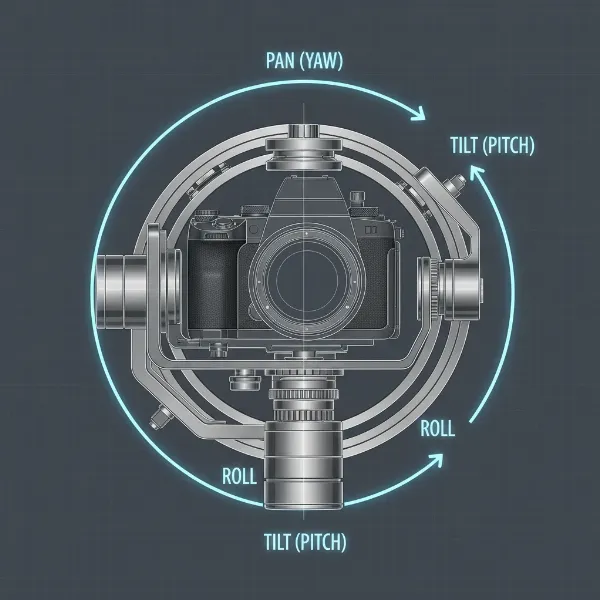 A detailed illustration showing the three axes of a camera gimbal: pan, tilt, and roll, with arrows indicating their directions.
Deep Dive into Essential Gimbal Modes
While many gimbals offer a variety of specialized modes, Pan Follow, Lock, and FPV are the foundational modes you’ll encounter and utilize most frequently. Understanding their mechanics and applications is crucial for controlling your camera’s motion with confidence and creativity.
Pan Follow (PF) Mode: The Horizontal Hero
Pan Follow mode, often abbreviated as PF, is arguably one of the most frequently used gimbal settings. In this mode, the gimbal allows your camera to smoothly follow your horizontal (pan) movements from left to right, or vice versa. Crucially, the tilt and roll axes remain locked, meaning your camera’s vertical angle and horizon will stay perfectly level, regardless of how you move the gimbal handle up or down, or if you rotate your wrist.
This mode is ideal for tracking subjects as they move across a scene, creating sweeping landscape shots, or executing smooth arc shots where you circle a subject while keeping it centered. Vloggers often favor Pan Follow mode for its ability to keep the horizon flat and the subject consistently framed while the operator walks and turns. It’s also excellent for dynamic reveal shots, where you smoothly pan to unveil an object or scene. For example, when following a cyclist down a path, Pan Follow mode ensures a stable horizontal track without unintended vertical shifts or tilting horizons.
Lock Mode: The Steady Gaze
The Lock Mode, sometimes referred to as Tilt Lock or All-Locked Mode on certain gimbals, does exactly what its name implies: it locks all three axes (pan, tilt, and roll). This means your camera will point in a completely fixed direction, holding its orientation relative to the world, regardless of how you move the gimbal handle. Your physical movements will simply translate the camera through space without altering its perspective.
This mode is invaluable for shots requiring a consistently static frame, even if the camera operator is moving. Think of push-in or pull-out shots along a straight path, where the camera glides towards or away from a subject without any rotation. It’s also perfect for maintaining a long-distance shot on a static target while you walk. While the technical “gimbal lock” is a mechanical phenomenon to avoid, this user-selectable “Lock Mode” is a powerful creative tool. It allows for precision in framing and movement, such as meticulously pushing the camera towards a captivating detail without any rotational drift.
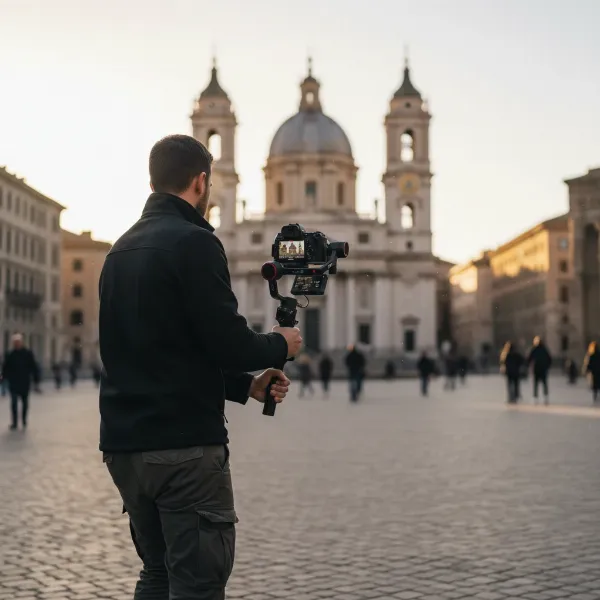 A person operating a camera gimbal in lock mode, maintaining a fixed shot on a distant subject while walking forward.
FPV (First Person View) Mode: Embrace the Immersion
For those looking to add a dynamic, immersive, and often exhilarating feel to their footage, FPV mode is the go-to setting. In FPV mode, all three axes – pan, tilt, and roll – are unlocked and will follow the movement of your hand. This means that if you tilt the gimbal, the camera tilts; if you roll it, the camera rolls. The camera essentially becomes an extension of your body, mimicking your exact perspective.
The result is a fluid, “roller coaster” like aesthetic, creating a sense of being directly within the action. FPV mode is ideal for simulating drone-like movements, achieving dramatic 360-degree barrel rolls, or capturing highly energetic and creative shots that fully immerse the viewer. It’s fantastic for sports, action sequences, or any scenario where you want to convey a strong sense of movement and dynamic perspective. Imagine navigating through a bustling market; FPV mode can translate every twist and turn of your body into a captivating, immersive shot.
> “Understanding your gimbal’s modes is like learning a new language for your camera. Each mode offers a distinct ‘voice’ for your storytelling, allowing you to articulate specific emotions and movements.” – Alex Chen, Professional Cinematographer and Stabilizer Expert
Other Common Gimbal Modes to Know
While Pan Follow, Lock, and FPV are fundamental, many modern gimbals offer additional modes that enhance versatility:
- Pan & Tilt Follow (PTF) / Full Follow Mode: Often the default setting, this mode allows both the pan and tilt axes to follow your movements, while the roll axis remains locked, keeping the horizon level. This is perfect for more dynamic tracking shots that involve both horizontal and vertical shifts, such as following a subject running up a hill or capturing a reveal by tilting up a building while panning across its facade.
- Sport Mode: Designed for fast-moving action, Sport mode increases the responsiveness of the gimbal motors, allowing for quicker and more agile camera movements to keep up with subjects.
- Vortex/Inception Mode: This creative mode rotates the camera 360 degrees along the roll axis, creating a captivating “barrel roll” effect, popular for music videos and artistic transitions.
- Portrait Mode: For smartphone gimbals, this mode quickly switches the phone’s orientation from landscape to portrait, perfect for social media content.
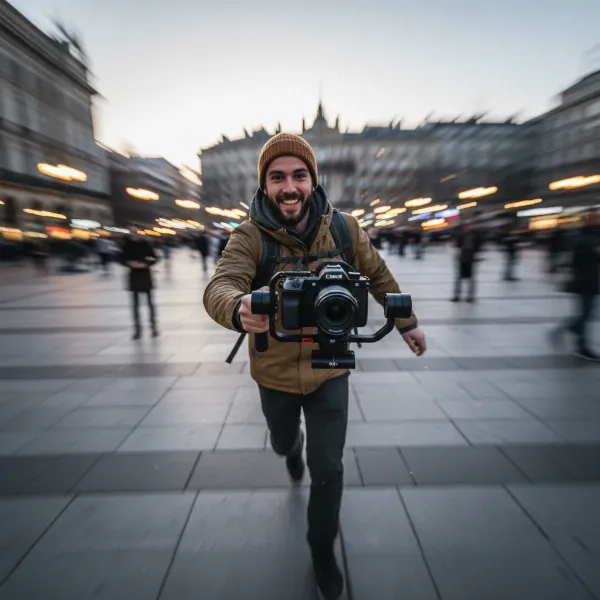 A videographer using a gimbal in an FPV or Vortex mode, creating a dynamic, immersive shot with a tilted horizon.
Choosing the Right Gimbal Mode for Your Shot
Selecting the optimal gimbal mode for your footage can dramatically impact the final outcome. It’s not about finding a “best” mode, but rather the right mode for the right moment.
Consider your subject and the type of movement you want to capture. Are you following a person walking calmly in a straight line? Pan Follow is excellent. Do you need to keep a specific landmark perfectly framed while you navigate around it? Lock Mode will be your ally. Are you aiming for an energetic, adrenaline-pumping sequence that mimics a bird in flight? FPV mode will deliver.
The desired cinematic effect is also a crucial factor. For smooth, professional tracking shots that maintain a level horizon, Pan Follow or Pan & Tilt Follow are ideal. For artistic, disorienting, or intensely immersive sequences, FPV or Vortex modes shine. Always experiment before a critical shoot to understand how each mode translates your movements into camera motion.
| Mode | Axes Controlled | Best For | Example Shots |
|---|---|---|---|
| Pan Follow (PF) | Pan follows, Tilt & Roll locked | Smooth horizontal tracking, stable vlogging, arc shots, landscapes | Following a person walking, panning across a cityscape, circling a statue. |
| Lock Mode | All axes locked (fixed direction) | Static framing, push-in/pull-out, long-distance steady shots | Gliding directly towards a subject, maintaining a consistent view from a moving vehicle. |
| FPV (First Person View) | All axes follow (pan, tilt, roll) | Dynamic, immersive, creative, drone-like, 360 spins | Simulating a rollercoaster, extreme sports footage, creative transitions, virtual reality experiences. |
| Pan & Tilt Follow (PTF) | Pan & Tilt follow, Roll locked | Dynamic tracking with vertical and horizontal movement, reveal shots | Following a runner up stairs, tilting up a building while moving forward, dynamic walk-throughs. |
Pro Tips for Mastering Your Gimbal Modes
Even with a solid understanding of gimbal modes, practical application requires finesse. Here are some pro tips to help you get the smoothest shots:
- Practice Balancing: A perfectly balanced gimbal is the foundation of smooth footage. Imbalance strains the motors and leads to jerky movements, regardless of the mode. Dedicate time to precise balancing before every shoot.
- Experiment Continuously: Don’t shy away from trying different modes for unexpected results. What might seem unconventional on paper could unlock a unique creative vision for your project.
- Smooth Operator: Remember that the gimbal stabilizes your movements. The smoother and more controlled your physical movements, the more refined and cinematic your final footage will be. Avoid sudden jerks or rapid changes in direction, especially in modes where axes are unlocked.
- Utilize Slow-Motion: Pairing specific gimbal modes with slow-motion recording can create breathtaking, dreamlike sequences, emphasizing the fluid camera movement.
- Pre-visualize Your Shot: Before hitting record, mentally (or physically, with a dry run) rehearse your camera movement and the mode you intend to use. This helps ensure your chosen mode aligns with your creative vision.
Expert Advice on Gimbal Mode Selection
Knowing the technical aspects is one thing, but applying them with an experienced eye makes all the difference. As a technician with over a decade of experience, I’ve seen countless filmmakers transform their work by intelligently choosing their gimbal modes. The biggest piece of advice? Don’t be afraid to switch modes frequently within a single scene to achieve different visual impacts. Often, a compelling video is a tapestry woven from various gimbal techniques.
> “The true magic of a gimbal isn’t just its ability to stabilize, but its power to translate your creative intent into fluid motion. Each mode is a brushstroke; learn to use them all.” – Admin of StabilizerPro.com, Camera Stabilizer Expert
Conclusion
Gimbal modes are the unsung heroes behind countless professional-looking videos, offering precise control over your camera’s movement and perspective. By understanding the distinct functionalities of Pan Follow, Lock, and FPV modes, alongside other common settings, you gain the power to craft everything from steady tracking shots to dynamic, immersive sequences. Experimentation and practice are your best allies in mastering these tools, allowing you to unlock new creative possibilities and tell your stories with unparalleled cinematic flair. Which gimbal mode will you master first to elevate your next video project?
Frequently Asked Questions
What are the main axes a camera gimbal operates on?
A camera gimbal primarily operates on three axes: Pan (horizontal rotation), Tilt (vertical up and down movement), and Roll (rotation along the lens axis, keeping the horizon level). These three axes work together to stabilize your camera and allow for controlled movements.
When should I use Pan Follow mode over other modes?
Pan Follow mode (PF) is ideal when you want your camera to smoothly track horizontal movements, such as following a subject walking or panning across a landscape, while keeping the vertical angle and horizon perfectly level. It’s excellent for vlogging and general cinematic tracking.
Is “Gimbal Lock” a mode I should use?
The “Gimbal Lock” phenomenon (a mechanical issue where two axes align, causing loss of control) should generally be avoided. However, many gimbals have a user-selectable Lock Mode, which is a desired setting. This mode intentionally locks all three axes, keeping your camera fixed on a single point regardless of how you move the gimbal, which is useful for push-in/pull-out shots.
How does FPV mode differ from Pan & Tilt Follow mode?
FPV (First Person View) mode unlocks all three axes (pan, tilt, and roll), allowing the camera to mimic your body’s exact movements, including banking and tilting for a highly immersive feel. Pan & Tilt Follow mode, on the other hand, unlocks only the pan and tilt axes, keeping the roll axis locked to maintain a level horizon while still allowing for dynamic horizontal and vertical movements.
Can beginners effectively use all gimbal modes?
Yes, beginners can certainly learn to use all gimbal modes. Starting with Pan Follow or Pan & Tilt Follow is often recommended for getting a feel for basic stabilization. With practice and understanding of each mode’s purpose, even complex modes like FPV can be mastered to create stunning, professional-looking footage.