Capturing buttery-smooth, cinematic footage with a camera gimbal is a game-changer for videographers. Yet, achieving consistently sharp focus, especially with dynamic movements or shallow depth of field, presents a unique challenge. Juggling gimbal operation while manually adjusting your lens can be a recipe for missed shots. This is where dedicated follow focus systems become indispensable. They offer the precision and control needed to elevate your gimbal work, whether through the cutting-edge technology of LiDAR or the time-tested reliability of motorized manual systems. Let’s delve into these options to help you choose the best follow focus system for your filmmaking needs.
 Videographer operating a camera on a gimbal with a follow focus system for cinematic footage.
What is a Follow Focus System and Why Do You Need It on a Gimbal?
A follow focus system is a mechanism that allows a camera operator or a dedicated focus puller to precisely control the focus of a lens. Traditionally, this involved a handwheel connected via gears to the lens’s focus ring. In the context of gimbals, however, direct manual interaction with the lens is often impractical or impossible without introducing unwanted camera shake. This makes electronic and wireless follow focus systems a necessity for gimbal users.
Gimbals excel at stabilizing your camera, enabling fluid motion shots that are otherwise impossible. However, the very nature of gimbal operation—keeping the camera balanced and its movements smooth—means physically touching the lens to adjust focus is usually out of the question. Follow focus systems solve this by providing remote control over your lens’s focus ring, allowing you to maintain perfect sharpness during complex camera movements. This functionality is crucial for achieving professional-looking video, executing smooth rack focuses between subjects, and harnessing the creative power of a shallow depth of field without sacrificing clarity.
Understanding LiDAR Follow Focus Systems
LiDAR, an acronym for Light Detection and Ranging, represents a significant leap forward in follow focus technology. Originally used in fields like autonomous vehicles and surveying, LiDAR is now revolutionizing camera focus systems.
How LiDAR Technology Works for Focus
|
Our Picks for the Best Camera Stabilizer in 2026
As an Amazon Associate I earn from qualifying purchases.
|
||
| Num | Product | Action |
|---|---|---|
| 1 | 3-Shoe DSLR/Mirrorless/Action Camera Camcorder Phone Stabilizer Expansion Cage Mount Moviemaking Holder Rig YouTube Tiktok Vlogging Video Kit Compatible with GoPro Canon Nikon Sony iPhone Android |

|
| 2 | DJI RS 3 Mini, 3-Axis Gimbal Stabilizer for Cameras Canon/Sony/Panasonic/Nikon/Fujifilm, 2 kg (4.4 lbs) Tested Payload, Camera Gimbal with Native Vertical Shooting, Black |
|
| 3 | DJI Osmo Mobile 7P Gimbal Stabilizer for iPhone, Android, Native Tracking, Lighting, 3-Axis Phone Gimbal, Quick Launch, One-Tap Edit, Built-in Extension Rod & Tripod, 10hrs Use, Phone Charging |
|
| 4 | Zeadio Video Action Stabilizing Handle Grip Handheld Stabilizer with Cold-Shoe Mount for All DSLR Camera Camcorder |
|
| 5 | FeiyuTech SCORP 2 Gimbal Stabilizer for DSLR and Mirrorless Camera, Integrated Al Tracking Sensor, 3-Axis Camera Stabilizer for Sony Canon Panasonic Nikon, 2.5kg Payload Touch Screen Vertical Shooting |
|
| 6 | DJI Osmo Mobile 7 Gimbal Stabilizer for iPhone, Android, Built-in Tripod, Portable Stabilizer for iPhone, Selfie Stick, 3-Axis Phone Gimbal, ActiveTrack 7.0, One-Tap Edit, 10hrs Use, Phone Charging |
|
| 7 | DJI Osmo Mobile 8 Advanced Tracking Combo Gimbal Stabilizer for Phone, AI Native Tracking with Audio & Lighting, 360° Pan Rotation, Built-in Extension Rod & Tripod, 10h Battery, Extension Rod |
|
| 8 | FeiyuTech SCORP 3 Gimbal Stabilizer for Camera, Built-in AI Tracking Sensor & Detachable Remote Control, 3.5KG Payload Camera Stabilizer with Touch Screen, Vertical Shooting |
|
| 9 |
|
|
| 10 | ZHIYUN CINEPEER Weebill 3E [Official], 3-Axis Lightweight Gimbal Stabilizer for DSLR & Mirrorless Camera Canon/Sony/Panasonic/Nikon, 3KG Payload, Native Vertical Shooting, Bluetooth Shutter Control |
|
LiDAR systems emit pulses of laser light and measure the time it takes for these pulses to return after bouncing off objects. This allows the system to accurately map the distance to various points in a scene, creating a real-time 3D depth map. When applied to follow focus, this depth information is used to automatically adjust the lens, ensuring the subject remains in sharp focus, even as distances change. Recent innovations, such as the DJI Focus Pro and PDMovie Live Air 3 Smart, integrate LiDAR technology directly or as an add-on, bringing advanced autofocus capabilities to virtually any manual focus lens.
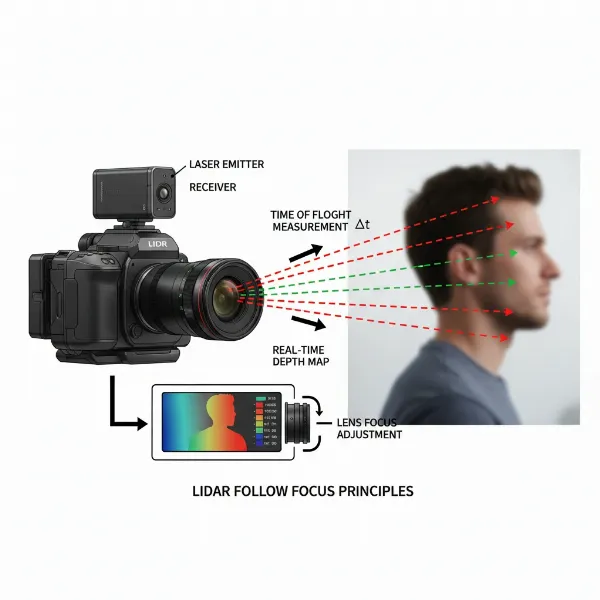 Diagram illustrating LiDAR technology for camera focus, showing laser pulses and depth mapping.
Advantages of LiDAR Follow Focus
The benefits of LiDAR follow focus are particularly appealing for gimbal operators and solo content creators:
- Autofocus Capabilities for Manual Lenses: Perhaps the most compelling advantage is LiDAR’s ability to imbue manual focus lenses with highly effective autofocus. This opens up a world of possibilities for filmmakers who prefer the look of vintage or cinema lenses but need the convenience of autofocus on a gimbal.
- Precise Subject Tracking: LiDAR systems often incorporate AI recognition, allowing them to detect and track subjects like people and cars with impressive accuracy. Some advanced systems can even maintain focus on a subject when it temporarily leaves the frame.
- Speed and Reactivity: By measuring distances directly and instantly, LiDAR can adjust focus with remarkable speed and responsiveness, crucial for dynamic shooting scenarios where subjects move unpredictably.
- Ideal for Solo Shooters: For a single operator managing both gimbal movement and camera settings, LiDAR autofocus significantly reduces the cognitive load, allowing them to concentrate more on composition and movement.
- Low-Light Performance: Unlike traditional camera autofocus systems that can struggle in dim conditions, LiDAR’s active illumination makes it highly effective in low-light environments. [cite: 3 in “pros and cons of LiDAR” search]
Disadvantages of LiDAR Follow Focus
Despite its groundbreaking features, LiDAR follow focus isn’t without its limitations:
- Cost: LiDAR systems, especially the more advanced ones like the DJI Focus Pro, represent a significant financial investment compared to basic mechanical follow focus units. [cite: 1, 4 in “pros and cons of manual focus” search]
- Environmental Sensitivity: While generally robust, the performance of LiDAR can be affected by adverse weather conditions such as heavy rain, snow, or dense fog, where water droplets can scatter the laser beams and reduce accuracy. Extremely bright, harsh light can also degrade performance. [cite: 1, 2, 3, 4 in “pros and cons of LiDAR” search]
- “Closest Object” Priority: Some LiDAR systems might default to focusing on the closest object in the frame, which might not always align with the desired creative focus point without manual intervention. [cite: 2 in “LiDAR follow focus systems” search]
- Battery Dependency: As electronic systems, LiDAR units require dedicated power sources, adding another battery to manage in your gear bag.
Exploring Manual Follow Focus Systems
When we talk about “manual” follow focus for gimbals, we’re typically referring to motorized, wireless systems that physically turn the focus ring of your lens. These systems bridge the gap between the tactile control of traditional manual focus and the remote operation needed for gimbals.
How Traditional Manual Follow Focus Systems Operate with Gimbals
A motorized manual follow focus system consists of a motor that attaches to your camera rig, with a gear that connects to the focus ring of your lens (either directly if it’s a cine lens, or via a gear ring if it’s a photo lens). This motor is then controlled wirelessly by a hand unit, often featuring a focus wheel, or sometimes directly from a wheel integrated into the gimbal itself. This setup allows for precise, remote adjustments to focus without touching the camera directly. Popular examples include the Tilta Nucleus-M and various SmallRig or Zhiyun servo motors. [cite: 1, 3, 4 in “manual follow focus” search]
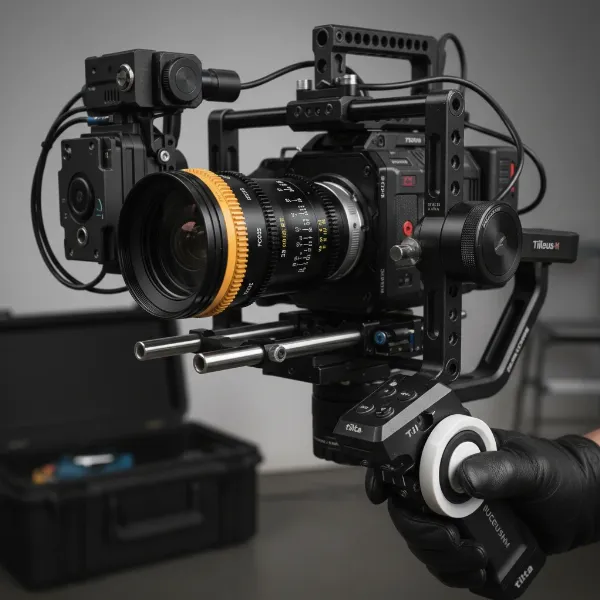 Motorized manual follow focus unit on a camera gimbal, showing the gear motor and wireless hand unit.
Advantages of Manual Follow Focus
For many filmmakers, the appeal of manual follow focus lies in its unparalleled control:
- Absolute Creative Control: A skilled operator can execute highly precise and nuanced focus pulls, dictating exactly where and when the focus shifts. This is invaluable for narrative filmmaking and shots requiring specific creative focus effects. [cite: 1, 2 in “pros and cons of manual focus” search]
- No “Hunting”: Unlike autofocus systems that might momentarily “hunt” for focus, a manual system goes exactly where you direct it, offering predictable and consistent results. [cite: 1 in “pros and cons of manual focus” search]
- Tactile Feedback: Many wireless hand units feature a physical focus wheel that provides a satisfying, haptic feel, allowing the focus puller to operate by feel rather than relying solely on a screen.
- Programmable A/B Stops: Many systems allow you to set precise “A” and “B” focus points, enabling repeatable rack focuses between two subjects or distances with perfect accuracy. [cite: 2, 3 in “LiDAR follow focus systems” search]
- Reliability: Once properly calibrated, a manual system can be incredibly reliable for rehearsed shots, consistently hitting marks every time.
Disadvantages of Manual Follow Focus
Despite its strengths, manual follow focus has its drawbacks, especially for gimbal users:
- Requires Skill and Often a Second Operator: Accurately pulling focus manually on a moving gimbal is one of the most challenging tasks in filmmaking. It often necessitates a dedicated focus puller (1st AC) who can anticipate action and precisely adjust focus. For a solo shooter, it can be extremely difficult to operate the gimbal and pull focus simultaneously, especially in dynamic situations. [cite: 4, 5 in “manual focus on gimbals” search]
- Potential for Camera Shake: While the system itself is remote, any slight bump or accidental contact with the camera rig while attempting to adjust a wired manual follow focus could induce shake. Wireless systems mitigate this.
- Slower for Unpredictable Movement: In fast-paced, unscripted environments, a manual system might be too slow to react to sudden changes in subject distance, potentially leading to out-of-focus shots. [cite: 1, 2 in “pros and cons of manual focus” search]
- Rig Complexity: Adding a motor, cables, and a hand unit can increase the size, weight, and complexity of your gimbal rig, which needs careful balancing.
- Lens Compatibility: While gear rings can adapt many photo lenses, cine lenses with built-in gears are ideal for seamless integration.
LiDAR vs. Manual: Which is Right for You?
The choice between LiDAR and manual follow focus systems for your gimbal setup depends heavily on your shooting style, budget, and creative priorities. Here’s a comparison to help you decide:
| Feature | LiDAR Follow Focus | Manual Follow Focus (Motorized) |
|---|---|---|
| Focus Method | Laser-based distance sensing & AI | Motor physically turns lens focus ring |
| Solo Shooter | Excellent (autofocus & tracking) | Challenging, often needs assistant |
| Precision | High (real-time distance data) | Very High (human judgment & practice) |
| Speed | Fast & reactive (autofocus) | Varies (operator skill, pre-programmed) |
| Creative Control | Good (subject selection, AF/MF switch) | Ultimate (exact marks, subjective feel) |
| Cost | Generally higher | Varies (basic to high-end wireless) |
| Weather Impact | Can be affected by rain/fog | Generally unaffected |
| Lens Type | Converts manual lenses to AF | Works with geared lenses (or rings) |
When to Choose LiDAR
Opt for a LiDAR follow focus system if:
- You’re a solo content creator or run-and-gun shooter. The automated tracking and autofocus capabilities make it significantly easier to maintain sharp focus while operating a gimbal alone.
- You frequently shoot dynamic subjects. Whether it’s sports, events, or fast-moving subjects, LiDAR’s speed and tracking excel in unpredictable scenarios.
- You want autofocus on your manual lenses. LiDAR effectively breathes new life into your vintage or cinema glass by adding modern AF functionality.
- You prioritize speed and ease of use. For quick setups and reliable focus without extensive practice, LiDAR is a strong contender.
When to Opt for Manual (Motorized)
Consider a motorized manual follow focus system if:
- You work with a crew, especially a dedicated focus puller (1st AC). This setup allows for the highest level of collaborative control and precision.
- You need precise, repeatable rack focuses. For narrative films, commercials, or any project demanding exact focus transitions, manual control with A/B stops is paramount.
- You desire ultimate creative control over every focus nuance. If you want to “feel” the focus and make subtle adjustments that an AI might miss, manual is the way to go.
- You operate in controlled environments. When you can plan and rehearse your shots, a manual system delivers consistent, professional results.
- You’re on a tighter budget for the core system. Basic motorized manual systems can be more affordable than entry-level LiDAR options, though high-end wireless manual systems can also be costly.
Top Follow Focus Systems for Gimbal Users
Here are some of the most popular and highly-regarded follow focus systems that excel in gimbal environments:
DJI Focus Pro – Next-Level LiDAR Autofocus
The DJI Focus Pro is a standalone LiDAR focus system designed to offer unparalleled autofocus capabilities, particularly with manual focus lenses. It integrates seamlessly with DJI’s Ronin gimbals but can also be used independently.
- Advantages: Features an impressive 20-meter (65-foot) tracking distance, AI subject recognition, and an Automated Manual Focus (AMF) mode that provides tactile feedback on the focus wheel even while in autofocus. It can turn any manual focus lens into an autofocus powerhouse, making it ideal for solo shooters and dynamic tracking shots.
- Disadvantages: It’s a premium product with a higher price point. While versatile, its full feature set is best utilized within the DJI ecosystem.
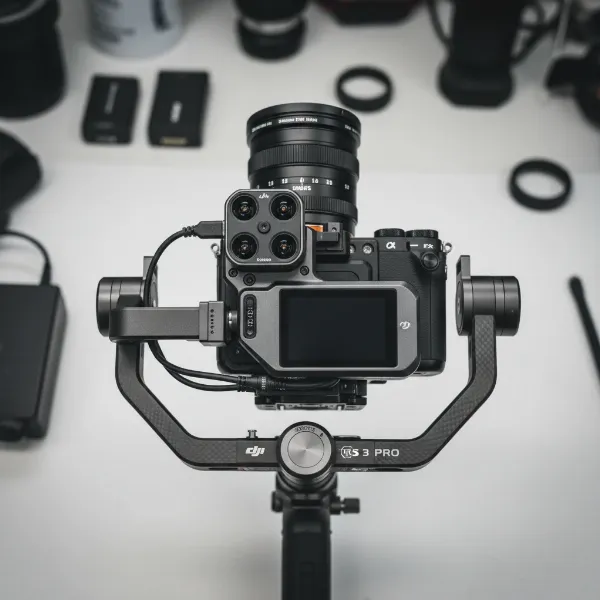 DJI Focus Pro LiDAR system seamlessly integrated with a DJI Ronin gimbal and camera.
PDMovie Live Air 3 Smart – Budget-Friendly LiDAR
The PDMovie Live Air 3 Smart offers LiDAR integration in a more accessible and independent package. It’s a wireless follow focus system that brings LiDAR’s benefits to a wider range of setups.
- Advantages: Its LiDAR module works independently of the gimbal, allowing for versatile use on tripods, handheld rigs, or gimbals without being tethered. It supports A/B focus points and adjustable focus speeds, providing a good balance of automation and control at a more budget-friendly price than some alternatives.
- Disadvantages: While effective, its LiDAR might prioritize the closest object by default, requiring operator awareness. Its technology might not be as advanced as DJI’s latest offerings in terms of AI tracking depth.
Tilta Nucleus-M – Professional Wireless Manual
The Tilta Nucleus-M is an industry-standard wireless follow focus system, widely adopted in professional productions for its robust build and precise control.
- Advantages: Known for its reliability, long wireless range, and highly accurate motors, the Nucleus-M offers granular control over focus, iris, and zoom (FIZ). Its modular design allows for customization, and the hand unit provides excellent tactile feedback for experienced focus pullers. It’s built for demanding professional environments where precise, repeatable focus pulls are paramount.
- Disadvantages: It’s a significant investment and adds substantial weight and components to your rig. While versatile, it typically requires a dedicated focus puller to maximize its potential, making it less ideal for true solo gimbal operation without extensive practice.
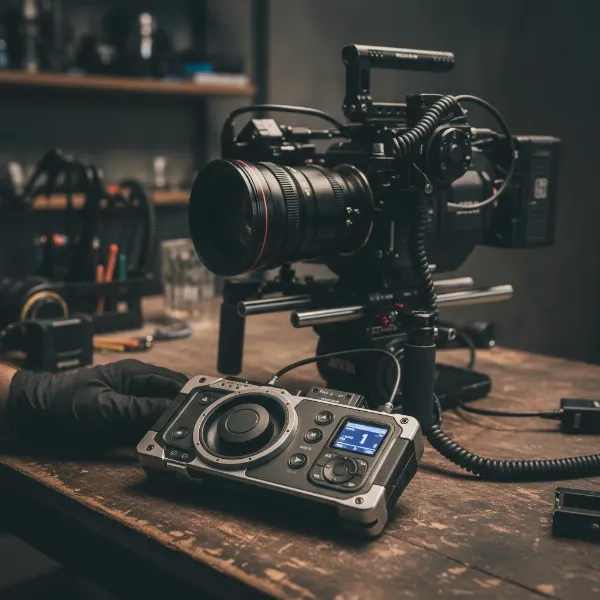 Tilta Nucleus-M wireless follow focus system with hand unit and motor for precise FIZ control.
Maximizing Your Gimbal Shots: Tips for Using Follow Focus
Regardless of whether you choose LiDAR or a motorized manual system, these tips will help you get the most out of your follow focus setup on a gimbal:
- Balance Your Gimbal Meticulously: Any added accessory, including a follow focus motor and its accompanying gears, will affect your gimbal’s balance. Take the time to achieve perfect balance, as this ensures smooth operation and prevents motor strain.
- Calibrate Your System: Both LiDAR and motorized manual systems require calibration. LiDAR needs to accurately map distances, and manual motors need to learn the full range of your lens’s focus throw. Proper calibration is key to accuracy.
- Practice, Practice, Practice: Especially for manual focus pulling, muscle memory is critical. Rehearse your movements and focus pulls until they become second nature. Even with LiDAR, understanding how the system tracks and when to intervene manually is important.
- Utilize an External Monitor: A large, bright external monitor mounted to your gimbal or carried by your focus puller provides a much clearer view of your focus, especially when shooting with shallow depth of field. Many monitors offer focus assist tools like peaking.
- Learn Your Gimbal’s Integrated Controls: Many modern gimbals offer integrated wheels or buttons that can control a connected follow focus motor. Familiarize yourself with these controls for more ergonomic operation.
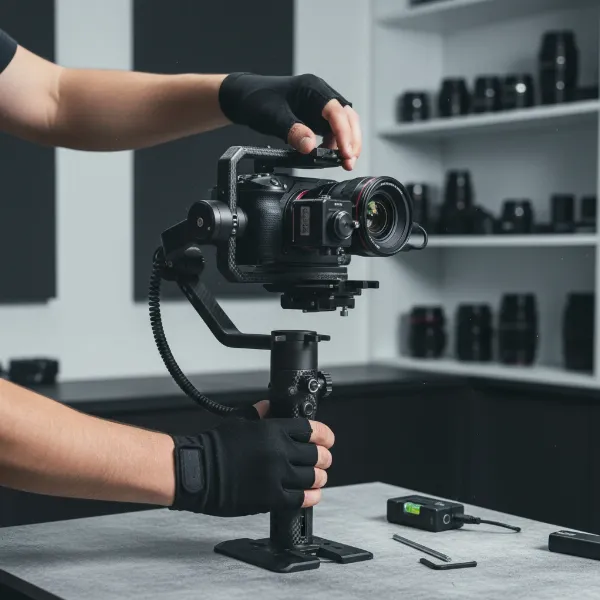 Filmmaker meticulously balancing a camera and gimbal rig with follow focus components for smooth shots.
Investing in Precision: Buying Guide for Follow Focus Systems
Choosing the right follow focus system is an investment in your craft. Consider these factors before making your decision:
Assess Your Shooting Style and Needs
Are you primarily a solo shooter creating vlogs and documentaries, or do you work on professional narrative productions with a team? Do you shoot fast-paced action or controlled, artistic shots? Your typical content and working environment will strongly influence whether an automated LiDAR system or a precise manual system is better.
Consider Compatibility
Ensure the follow focus system is compatible with your existing gear. Check camera compatibility for electronic control, lens compatibility (especially if using photo lenses that might need gear rings), and crucially, gimbal compatibility for mounting, power, and integrated control options.
Set Your Budget
Follow focus systems range from a few hundred dollars for basic motorized units to several thousand for high-end LiDAR and FIZ systems. Determine how much you’re willing to invest, keeping in mind the long-term benefits to your workflow and production quality. Remember that while LiDAR systems often have a higher entry price, some independent LiDAR options are becoming more affordable.
Research and Reviews
Before purchasing, dive into real-world reviews and comparisons. Look for insights into latency, motor strength, battery life, user-friendliness, and reliability in various shooting conditions. This will help you identify systems that perform consistently and meet the demands of your projects.
“The right follow focus system isn’t just a piece of gear; it’s an extension of your creative vision. It empowers you to tell your story with unparalleled clarity, ensuring every frame is exactly as you intend.” – Sarah Chen, Award-Winning Cinematographer
Conclusion
The world of filmmaking is constantly evolving, and focus systems for gimbal users are no exception. Both LiDAR and motorized manual follow focus technologies offer distinct advantages, each designed to tackle the critical challenge of maintaining sharp focus on moving shots. LiDAR systems, with their intelligent autofocus and tracking capabilities, are revolutionizing efficiency for solo shooters and dynamic environments. Meanwhile, motorized manual systems continue to provide the ultimate creative precision and tactile control favored by seasoned focus pullers and narrative filmmakers. Your choice hinges on understanding your specific workflow, the types of stories you tell, and your preferred level of automation versus hands-on control. By carefully considering these factors, you can invest in a follow focus system that not only enhances your gimbal work but truly elevates your entire filmmaking journey.
Which follow focus system will unlock the next level of precision for your gimbal shots?
Frequently Asked Questions
Can I use a traditional mechanical follow focus directly on a gimbal?
Directly using a purely mechanical follow focus on a gimbal is generally not feasible because it requires you to physically touch the lens, which will introduce unwanted shakes and disrupt the gimbal’s balance and smooth operation. For gimbals, you need a system that allows remote focus adjustment, typically via a motor.
Do I need a separate monitor for follow focus?
While not strictly mandatory, an external monitor is highly recommended for follow focus, especially with shallow depth of field. It provides a larger, clearer view of your image, making it much easier to judge focus accurately and see what your LiDAR system is tracking or where your manual pull is landing.
Can LiDAR follow focus work with any lens?
Many modern LiDAR follow focus systems, like the DJI Focus Pro, are designed to work with a wide range of manual focus lenses, effectively converting them into autofocus lenses. They achieve this by using a motor to turn the physical focus ring based on LiDAR’s distance measurements.
What is “rack focus”?
Rack focus is a filmmaking technique where the focus shifts from one subject or depth of field to another within the same shot. This draws the viewer’s attention to a different part of the scene and is a powerful storytelling tool. Both LiDAR (by selecting a new subject) and manual follow focus (by performing a precise focus pull) can achieve this effect.
Is autofocus on a camera good enough for gimbal shots?
While modern camera autofocus (AF) systems have improved significantly, they still have limitations, especially in complex or fast-moving gimbal shots. They can sometimes “hunt” for focus, struggle with specific subjects, or focus on unintended objects. Dedicated follow focus systems offer more consistent and precise results, or complete creative control, surpassing built-in camera AF for critical video work.