Long exposure photography, an art form that transforms fleeting moments into timeless visual narratives, thrives on absolute stillness. Conversely, a camera gimbal is engineered for dynamic, fluid motion, stabilizing your camera through movement. At first glance, these two powerful tools seem to be at odds, presenting a perplexing challenge for photographers aiming to merge their capabilities. However, with the right approach and a clear understanding of their distinct roles, a gimbal can become an invaluable asset in your long exposure toolkit, offering unparalleled precision in composition and opening up new creative avenues that static setups simply can’t match.
Understanding Gimbals and Long Exposure: A Fundamental Clash?
At its core, long exposure photography is about allowing light to hit the camera sensor over an extended period, ranging from a few seconds to several minutes. This technique is renowned for blurring moving elements like water, clouds, or light trails, while keeping stationary subjects razor-sharp. The absolute prerequisite for such sharpness is an unmoving camera, typically achieved with a robust tripod.
Conversely, an electronic camera gimbal is a sophisticated device designed to counteract unwanted camera shake and vibrations, ensuring smooth, cinematic footage even when the photographer is on the move. Its motors and sensors actively stabilize the camera across multiple axes, making it a staple for videographers and action photographers. The inherent function of a gimbal is to enable motion without introducing blur from hand movements.
This creates an apparent conflict: long exposure demands stillness, while a gimbal facilitates motion. Attempting handheld long exposure with a gimbal, expecting its stabilization to compensate for several seconds of exposure, will almost always result in blurry images. The minuscule, constant adjustments a gimbal makes, though imperceptible in video, become detrimental during a prolonged capture.
The Gimbal’s Role in Long Exposure: More Than Just Stabilization
Given this fundamental difference, how can a gimbal contribute to long exposure photography? The answer lies not in its active stabilization during the exposure itself, but in its ability to offer precise control and framing before the shutter is released, and for certain creative, non-traditional long exposure effects.
While you won’t be handholding a gimbal for a 30-second long exposure, you can leverage its smooth articulation to achieve a perfect composition. Imagine setting up your camera on a sturdy tripod. Instead of making finicky adjustments to the tripod head, you can mount your camera onto a gimbal, then mount the gimbal onto the tripod. This allows you to fluidly pan, tilt, and roll the camera with unmatched precision, finding that exact angle and framing for your shot. Once your composition is locked in, you can then engage the gimbal’s “lock” or “static” mode, or simply power it off, effectively turning it into a stable, precisely positioned platform before initiating the long exposure.
For certain niche applications, a gimbal can also enable controlled movement during a slow shutter speed shot, producing unique motion blur effects. This isn’t traditional static long exposure, but rather an exploration of intentional camera movement (ICM) combined with slow shutter speeds, creating abstract and artistic images where motion itself becomes the subject.
Essential Gear and Setup for Gimbal-Assisted Long Exposure
To successfully integrate a gimbal into your long exposure workflow, you need more than just the gimbal itself. A combination of specialized equipment and careful setup is paramount.
A Sturdy Tripod: Your Primary Foundation
|
Our Picks for the Best Camera Stabilizer in 2026
As an Amazon Associate I earn from qualifying purchases.
|
||
| Num | Product | Action |
|---|---|---|
| 1 | Zeadio Video Action Stabilizing Handle Grip Handheld Stabilizer with Cold-Shoe Mount for All DSLR Camera Camcorder |

|
| 2 | DJI Osmo Mobile 7 Gimbal Stabilizer for iPhone, Android, Built-in Tripod, Portable Stabilizer for iPhone, Selfie Stick, 3-Axis Phone Gimbal, ActiveTrack 7.0, One-Tap Edit, 10hrs Use, Phone Charging |
|
| 3 | 3-Shoe DSLR/Mirrorless/Action Camera Camcorder Phone Stabilizer Expansion Cage Mount Moviemaking Holder Rig YouTube Tiktok Vlogging Video Kit Compatible with GoPro Canon Nikon Sony iPhone Android |
|
| 4 | Zeadio Camera Stabilizer Kit, All-in-One Handheld Stabilizer with LED Video Light, Microphone, Phone Holder & Action Camera adaper, Fits for All Camera, DSLR, Action Camera and All Smartphones |
|
| 5 | DJI Osmo Mobile 8 Advanced Tracking Combo Gimbal Stabilizer for Phone, AI Native Tracking with Audio & Lighting, 360° Pan Rotation, Built-in Extension Rod & Tripod, 10h Battery, Extension Rod |
|
| 6 | FeiyuTech SCORP 2 Gimbal Stabilizer for DSLR and Mirrorless Camera, Integrated Al Tracking Sensor, 3-Axis Camera Stabilizer for Sony Canon Panasonic Nikon, 2.5kg Payload Touch Screen Vertical Shooting |
|
| 7 | DJI Osmo Mobile 7P Gimbal Stabilizer for iPhone, Android, Native Tracking, Lighting, 3-Axis Phone Gimbal, Quick Launch, One-Tap Edit, Built-in Extension Rod & Tripod, 10hrs Use, Phone Charging |
|
| 8 | ZHIYUN CINEPEER Weebill 3E [Official], 3-Axis Lightweight Gimbal Stabilizer for DSLR & Mirrorless Camera Canon/Sony/Panasonic/Nikon, 3KG Payload, Native Vertical Shooting, Bluetooth Shutter Control |
|
| 9 | FeiyuTech SCORP 3 Gimbal Stabilizer for Camera, Built-in AI Tracking Sensor & Detachable Remote Control, 3.5KG Payload Camera Stabilizer with Touch Screen, Vertical Shooting |
|
| 10 | DJI RS 3 Mini, 3-Axis Gimbal Stabilizer for Cameras Canon/Sony/Panasonic/Nikon/Fujifilm, 2 kg (4.4 lbs) Tested Payload, Camera Gimbal with Native Vertical Shooting, Black |
|
For any true long exposure, a robust tripod remains the undisputed champion. It provides the unwavering stability necessary to keep your camera perfectly still for extended periods. When using a gimbal for precision framing, the gimbal should be securely mounted on this tripod. Look for tripods with heavy-duty legs and a stable head, capable of supporting the combined weight of your camera and gimbal without any sag or wobble.
The Right Gimbal: Stability and Payload Capacity
While the gimbal’s active stabilization might be disengaged during the exposure, its build quality and payload capacity are still important. A well-balanced camera on a capable gimbal will maintain its position more reliably once locked or powered off. Ensure your gimbal can comfortably handle the weight of your camera and lens combination, especially if you’re using heavier DSLR setups or large mirrorless systems with telephoto lenses. For mobile photographers, even a small phone gimbal can be beneficial for pre-composition when mounted on a mini-tripod.
Camera & Lens Choices: Manual Control is Key
Your camera should offer full manual control over aperture, shutter speed, and ISO. A camera that can shoot in RAW format is highly recommended for maximum post-processing flexibility. Lenses with a wide aperture range are also beneficial, as you’ll often be stopping down to achieve longer exposures. Manual focus capabilities are crucial for precise sharpness, especially in low-light conditions where autofocus might struggle.
ND Filters & Remote Shutter: Indispensable Accessories
Neutral Density (ND) filters are absolutely essential for long exposure photography, especially during daylight hours. They reduce the amount of light entering the lens without affecting color, allowing you to achieve very slow shutter speeds even in bright conditions. A remote shutter release (wired or wireless) is another non-negotiable accessory. Pressing the camera’s shutter button can introduce micro-vibrations, ruining a long exposure shot. A remote trigger eliminates this risk, ensuring your camera remains perfectly still throughout the exposure.
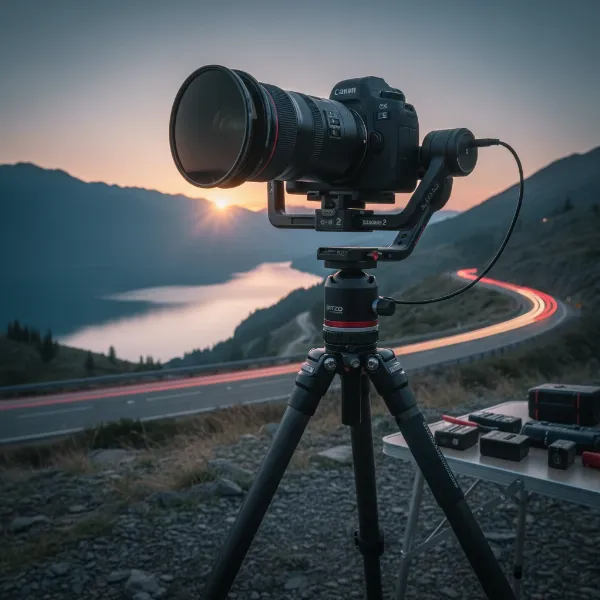 A camera gimbal mounted on a sturdy tripod with a DSLR camera attached, ready for long exposure photography.
Step-by-Step Guide: Mastering Gimbal-Enhanced Long Exposure
Integrating your gimbal into a long exposure workflow requires a deliberate, step-by-step approach to ensure optimal results.
Step 1: Secure Your Setup
Begin by attaching your camera to the gimbal, ensuring it is perfectly balanced. This is crucial even if you plan to lock the gimbal, as good balance reduces strain on the motors and ensures the camera rests naturally. Once the camera is balanced, securely mount the entire gimbal unit onto your sturdy tripod. Double-check all connections to eliminate any potential wobble.
Step 2: Power On and Frame Your Shot with Precision
With your setup secure, power on the gimbal. Utilize its smooth, intuitive controls to carefully frame your composition. The gimbal’s precise movement allows for minute adjustments that can be challenging with a standard tripod head. Take your time to get the horizon perfectly level, and position your subject exactly where you want it within the frame.
Step 3: Dial in Camera Settings
Before taking the shot, set your camera to manual mode.
- ISO: Keep your ISO as low as possible (typically 100 or 200) to minimize digital noise.
- Aperture: Choose an appropriate aperture (e.g., f/8 to f/16) to achieve sufficient depth of field and, when combined with an ND filter, the desired long shutter speed.
- Shutter Speed: This will be your primary variable, determined by ambient light and the ND filter used. Start with an estimate and adjust as needed.
Step 4: Focus Accurately
Switch your lens to manual focus. If shooting in low light, use your camera’s Live View feature to zoom in on your subject and achieve critical focus. Once focused, avoid touching the lens.
Step 5: Attach ND Filters and Lock the Gimbal
Once your settings are dialed in and focus is set, carefully attach your ND filter(s) to the lens. Now, here’s a critical step for long exposure: either power off your gimbal (if it naturally holds its position when off) or engage its “lock” mode on all axes if available. Some gimbals have a dedicated static mode. This essentially immobilizes the camera in its current, perfectly framed position, effectively turning the gimbal into a highly adjustable, yet perfectly stable, tripod head.
Step 6: Trigger the Shutter
Finally, use your remote shutter release to take the photograph. Avoid touching the camera or tripod during the exposure. Wait for the exposure to complete, review your shot, and make any necessary adjustments to your camera settings or ND filters for subsequent shots.
Creative Applications and When to Embrace the Combination
While not for handheld use, integrating a gimbal into your long exposure setup can unlock several creative opportunities:
- Architectural Photography: Achieve precise, level compositions for buildings and cityscapes, eliminating convergence lines with fine gimbal adjustments before locking and exposing.
- Nightscapes and Astrophotography (Fixed Camera): For milky way or star trail photography where the camera needs to remain absolutely still, the gimbal can aid in pinpoint framing and horizon leveling on the tripod.
- Controlled Motion Blur (Non-Traditional): For artistic shots where you want a specific, controlled camera movement during a slow shutter speed (e.g., a deliberate pan or tilt to create abstract streaks of light), a gimbal can execute these movements smoothly during a short, slow shutter exposure, creating effects distinct from traditional long exposure. This is an advanced technique and requires careful experimentation.
- Product and Still Life: For studio setups requiring meticulous framing and consistency across multiple shots, a gimbal on a stand can offer unparalleled positional accuracy.
Common Pitfalls and Troubleshooting
Even with the best preparation, challenges can arise when attempting gimbal-assisted long exposure.
- Micro-Vibrations: Even on a sturdy tripod, subtle vibrations from wind, nearby traffic, or an unstable surface can cause blur. Use a heavier tripod, lower your setup closer to the ground, or hang a weight from the tripod’s center column for added stability.
- Gimbal Battery Life: If you’re using the gimbal for extended periods of framing or for multiple shots, ensure it’s fully charged. While it won’t draw power during a locked exposure, pre-shot adjustments can drain it.
- Focus Issues in Low Light: Autofocus often struggles in dim conditions. Rely on manual focus, utilizing your camera’s Live View zoom and focus peaking features.
- “Ghosting” from Unlocked Gimbal: If the gimbal’s motors are active during a long exposure, even its tiny corrections can result in blurry or “ghosted” images. Always ensure the gimbal is locked or powered off for static long exposures.
> “When it comes to long exposure photography, stability is paramount. Think of your gimbal not as a handheld stabilizer for these specific shots, but as an advanced, infinitely adjustable tripod head that grants you unparalleled precision in composition. Once framed, lock it down; the magic happens with stillness.” – Admin, StabilizerPro.com, Camera Stabilizer Specialist
Buying Guide: Expert Advice
When considering gear for long exposure with a gimbal, always prioritize stability and compatibility.
- Assess Your Needs: Are you primarily shooting landscapes, cityscapes, or abstract motion blur? Your primary camera type (DSLR, mirrorless, smartphone) will dictate the gimbal’s size and payload capacity.
- Read Reviews and Compare Products: Look for gimbals known for their robust build and reliable locking mechanisms. Pay attention to user reviews regarding tripod mounting stability.
- Warranty and Support: Invest in reputable brands that offer good customer service and a solid warranty. This ensures peace of mind for your valuable equipment.
Conclusion
Combining a camera gimbal with long exposure photography might seem counterintuitive, given their opposing principles of motion and stillness. However, by understanding the gimbal’s true value in this context—as a tool for precise pre-shot framing and compositional fluidity—photographers can unlock a new level of control and creativity. The secret lies in a foundational setup: a sturdy tripod that provides the ultimate stillness, upon which a gimbal can be mounted, used for exact positioning, and then locked down. This hybrid approach transforms what appears to be a clash into a powerful synergy, allowing you to craft breathtaking long exposure images with unparalleled compositional accuracy. Are you ready to elevate your long exposure game with the strategic integration of a gimbal?
Frequently Asked Questions
Can I handhold a gimbal for long exposure photography?
No, handholding a gimbal for traditional long exposure photography (e.g., several seconds or more) is not recommended. Even with a gimbal’s stabilization, the minuscule movements of the motors and your body will introduce blur that is unacceptable for sharp long exposures. A sturdy tripod is always required for true stillness.
What camera settings are best for long exposure with a gimbal setup?
For long exposure photography, use manual mode. Set your ISO as low as possible (e.g., 100), choose a narrow aperture (f/8 to f/16) for depth of field and to extend shutter speed, and then adjust your shutter speed as needed, often using ND filters to achieve longer exposures. Manual focus is also highly recommended.
Do I need an ND filter when using a gimbal for long exposure?
Yes, ND filters are crucial for long exposure photography, regardless of whether you’re using a gimbal. They reduce the amount of light entering the lens, allowing you to use slower shutter speeds even in bright conditions, which is essential for achieving the characteristic motion blur of long exposures.
Should the gimbal be powered on or off during the long exposure shot?
For static long exposure photography, the gimbal should ideally be powered off or placed in a locked/static mode once you have achieved your desired composition. This prevents the motors from making any minor adjustments during the exposure, which could introduce blur. The tripod is responsible for stability during the shot.
What kind of gimbal is best for integrating with long exposure techniques?
Any professional-grade 3-axis electronic gimbal with good payload capacity that can securely mount onto a tripod will work. Look for gimbals that offer stable locking mechanisms or maintain their position well when powered off. The primary consideration is that it can hold your camera setup stably when not actively stabilizing.