Capturing buttery-smooth footage is no longer a luxury reserved for large film crews. Thanks to advancements in camera stabilizer technology, creators of all levels can achieve cinematic results with handheld gimbals. The Moza AirCross 3 emerges as a particularly intriguing contender in this space, boasting a truly unique and highly convertible design. But beyond its innovative aesthetics, does this camera stabilizer stand up to the rigors of real-world filmmaking? This in-depth review will dissect its features, performance, and overall practicality to help you decide if it’s the right tool to elevate your visual storytelling.
What is a Camera Stabilizer? Why You Need One.
A camera stabilizer is an essential tool designed to reduce unwanted camera shake and vibrations, ensuring your footage remains smooth, steady, and professional-looking. Imagine tracking a moving subject, performing a sweeping shot, or simply walking with your camera – without a stabilizer, the resulting video would likely be jarring and amateurish. By compensating for your movements, a good camera stabilizer transforms shaky clips into polished, cinematic sequences.
While various types exist, such as traditional Steadicam rigs or portable camera sliders, 3-axis motorized gimbals like the Moza AirCross 3 are incredibly popular for their balance of stability, versatility, and ease of use. They dynamically counter movements across three axes – pan, tilt, and roll – allowing for incredibly fluid shots that would be impossible to achieve handheld. For vloggers, documentary filmmakers, event videographers, or anyone serious about video quality, a reliable camera stabilizer is not just a luxury, but a fundamental piece of gear. It empowers you to capture stunning visuals, enhance storytelling, and deliver a more engaging viewing experience to your audience.
The Moza AirCross 3: A Deep Dive into Its Unique Design
The Moza AirCross 3 immediately distinguishes itself from many rivals through its innovative and highly adaptable design philosophy. Unlike traditional gimbals that offer a singular form factor, the AirCross 3 champions versatility, allowing filmmakers to rapidly transform its configuration to suit diverse shooting scenarios.
The Revolutionary Foldable Design
At the heart of the Moza AirCross 3’s unique appeal is its fully foldable structure. This isn’t just a minor tweak; it’s a complete redesign from its predecessors. The handle can be folded, significantly reducing the gimbal’s footprint to roughly the size of an A4 piece of paper. This impressive compactness makes it exceptionally travel-friendly, easily slipping into a camera bag, backpack, or even a daily carry-all without taking up excessive space.
But the folding mechanism offers more than just portability. It enables the AirCross 3 to transform into a “4-in-1 convertible” system, allowing for multiple shooting positions. These include:
- Classic Mode: The standard upright single-handle gimbal configuration.
- Sling Mode: By unfolding the handle and attaching a tripod foot or extension, the gimbal can be held underslung, perfect for achieving low-angle shots with minimal effort.
- Dual-Handle Mode: This configuration provides enhanced control and stability, ideal for more cinematic movements, often achieved by orienting the handle at 90 degrees and attaching a secondary grip.
- Briefcase Mode / Grip Extension: Similar to Sling Mode, this allows for effortless low-angle shooting and can be combined with optional grip extensions like a Slypod for dolly-like effects.
|
Our Picks for the Best Camera Stabilizer in 2026
As an Amazon Associate I earn from qualifying purchases.
|
||
| Num | Product | Action |
|---|---|---|
| 1 | 3-Shoe DSLR/Mirrorless/Action Camera Camcorder Phone Stabilizer Expansion Cage Mount Moviemaking Holder Rig YouTube Tiktok Vlogging Video Kit Compatible with GoPro Canon Nikon Sony iPhone Android |

|
| 2 | DJI Osmo Mobile 7P Gimbal Stabilizer for iPhone, Android, Native Tracking, Lighting, 3-Axis Phone Gimbal, Quick Launch, One-Tap Edit, Built-in Extension Rod & Tripod, 10hrs Use, Phone Charging |
|
| 3 | DJI RS 3 Mini, 3-Axis Gimbal Stabilizer for Cameras Canon/Sony/Panasonic/Nikon/Fujifilm, 2 kg (4.4 lbs) Tested Payload, Camera Gimbal with Native Vertical Shooting, Black |
|
| 4 | DJI Osmo Mobile 8 Advanced Tracking Combo Gimbal Stabilizer for Phone, AI Native Tracking with Audio & Lighting, 360° Pan Rotation, Built-in Extension Rod & Tripod, 10h Battery, Extension Rod |
|
| 5 | ZHIYUN CINEPEER Weebill 3E [Official], 3-Axis Lightweight Gimbal Stabilizer for DSLR & Mirrorless Camera Canon/Sony/Panasonic/Nikon, 3KG Payload, Native Vertical Shooting, Bluetooth Shutter Control |
|
| 6 | Zeadio Video Action Stabilizing Handle Grip Handheld Stabilizer with Cold-Shoe Mount for All DSLR Camera Camcorder |
|
| 7 | DJI Osmo Mobile 7 Gimbal Stabilizer for iPhone, Android, Built-in Tripod, Portable Stabilizer for iPhone, Selfie Stick, 3-Axis Phone Gimbal, ActiveTrack 7.0, One-Tap Edit, 10hrs Use, Phone Charging |
|
| 8 | FeiyuTech SCORP 2 Gimbal Stabilizer for DSLR and Mirrorless Camera, Integrated Al Tracking Sensor, 3-Axis Camera Stabilizer for Sony Canon Panasonic Nikon, 2.5kg Payload Touch Screen Vertical Shooting |
|
| 9 | FeiyuTech SCORP 3 Gimbal Stabilizer for Camera, Built-in AI Tracking Sensor & Detachable Remote Control, 3.5KG Payload Camera Stabilizer with Touch Screen, Vertical Shooting |
|
| 10 | Zeadio Camera Stabilizer Kit, All-in-One Handheld Stabilizer with LED Video Light, Microphone, Phone Holder & Action Camera adaper, Fits for All Camera, DSLR, Action Camera and All Smartphones |
|
This modularity is a game-changer for filmmakers who need to adapt quickly on location, moving between different shot types without changing equipment.
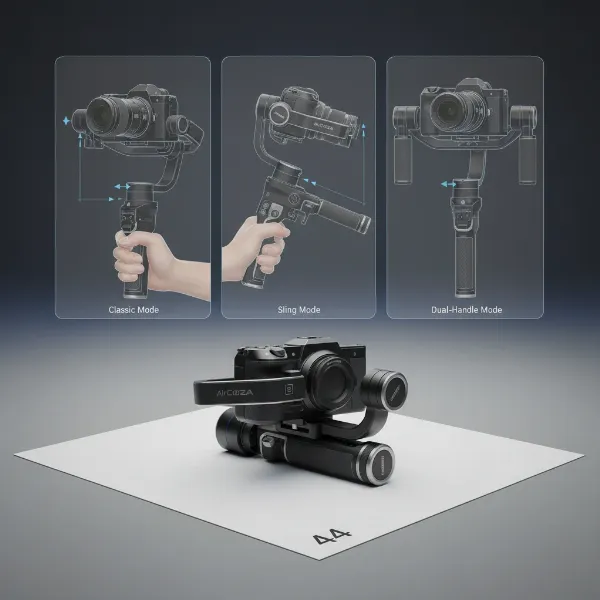 Moza AirCross 3 gimbal showcasing its foldable design and various shooting configurations for ultimate versatility.
Angled Motor Arm and Enhanced Ergonomics
Beyond its transformative capabilities, the Moza AirCross 3 incorporates several ergonomic improvements that enhance the user experience. A prominent feature is the angled motor arm, which provides an unobstructed view of your camera’s screen. This is a crucial detail often overlooked in gimbal design, ensuring you can frame your shots accurately without a motor blocking your line of sight.
The build quality itself marks a significant upgrade, transitioning from the AirCross 2’s plastic housing to a more durable metal construction. This not only gives the gimbal a premium feel but also contributes to its ruggedness, instilling confidence during demanding shoots. The handle is designed to be comfortable to hold, often featuring rubber padding for a secure grip, reducing fatigue during extended filming sessions. This attention to tactile feel and robust materials ensures the AirCross 3 is both a joy to use and built to last.
Intuitive Controls and User Interface
A powerful camera stabilizer is only as good as its user interface, and the Moza AirCross 3 aims for simplicity and efficiency. It features an updated OLED UI, providing clear and concise information at a glance. The layout of controls is logical and easily accessible, with a single start/stop/shutter button streamlining operation.
The flat, responsive joystick allows for precise camera movement, while a dedicated mode button cycles through essential shooting modes such as Pan Mode, Pan & Tilt Mode, FPV Mode, All Lock Mode, and the creative Inception Mode for dynamic barrel rolls. Additionally, a “smart trigger” button on the back of the grip offers quick access to axis locking, providing instant stability when vertical or horizontal motion is undesirable. This thoughtful control scheme allows filmmakers to quickly adjust settings and capture complex shots without fumbling through menus, ensuring focus remains on the creative process.
Is the Moza AirCross 3 Practical? Real-World Performance & Considerations
The Moza AirCross 3’s unique design certainly turns heads, but the ultimate question for any serious filmmaker is its practical utility in real-world shooting scenarios. Does its innovative structure translate into genuinely improved performance and workflow?
Payload and Camera Compatibility
With a maximum payload capacity of 3.2 kg (7.05 lbs), the Moza AirCross 3 is primarily designed for mirrorless cameras and smaller DSLR setups. This capacity is quite impressive for its compact size, accommodating popular cameras like the Sony a7S III with various zoom lenses. However, it’s crucial to consider not just the weight, but also the physical dimensions and clearances of your camera and lens combination. Some larger camera bodies, particularly those with wide or long lenses, might struggle to fit or balance optimally due to the gimbal’s physical constraints, even if they fall within the weight limit. For instance, cameras like the Blackmagic Pocket Cinema Camera 4K, while potentially within weight, might present balancing challenges due to their bulk. Therefore, verifying your specific camera and lens setup against the gimbal’s dimensions is a critical step for practical use.
Stabilization Performance
When it comes to the core function of a camera stabilizer – providing smooth, stable footage – the Moza AirCross 3 generally delivers. Reviews indicate that the gimbal performs admirably, even if the camera isn’t perfectly balanced, producing steady and fluid motion free from vibrations or horizon drift that can plague lesser gimbals. This robust stabilization capability is vital for professional results, allowing creators to walk, run, or perform intricate camera movements with confidence.
The gimbal’s various modes, including Pan, Pan & Tilt, FPV, All Lock, and Inception Mode, offer creative flexibility. “Inception” mode, for example, allows for dramatic 360-degree rolls, adding a dynamic flair to your shots. Furthermore, the inclusion of axis locks simplifies the balancing process, securing each axis individually to prevent unwanted movement, which is a significant practical advantage for quick setup and breakdown. The auto-tuning function, often accessible via a companion app, further optimizes performance, saving valuable time on set.
Battery Life and Power System
Practicality on a long shoot heavily relies on battery endurance, and the Moza AirCross 3 excels in this area. Equipped with a built-in 3500mAh battery and utilizing the MOZA Spark Power Supply System 3.0, it boasts an impressive run time of 15 to 20 hours on a single charge. This “all-day long shooting” capability means fewer interruptions and less concern about power depletion during critical moments.
For added convenience, the gimbal supports recharging via a USB Type-C port, allowing for easy power-ups from external power banks. A standout practical feature is its ability to also charge your camera while you shoot (with an optional adapter), essentially extending your camera’s battery life indefinitely. This dual-power functionality is a significant benefit for filmmakers working in the field, ensuring both the gimbal and the camera remain operational for extended periods.
Build Quality and Durability
The construction of the Moza AirCross 3 is a notable step up in practicality and perceived value. Made predominantly from metal, it offers a robust and durable feel in hand, a marked improvement over the more plastic-heavy design of its predecessor, the AirCross 2. This sturdy build quality instills confidence that the gimbal can withstand the rigors of frequent use and diverse shooting environments. The black matte finish is aesthetically pleasing, though some users note it can be prone to minor scratches with heavy use, a common trade-off for such finishes. Overall, the metal body contributes significantly to its professional appeal and long-term reliability.
Portability vs. Stability in Different Modes
The AirCross 3’s highly portable, foldable design is a major advantage for creators on the go. Its ability to condense to an A4 size makes it an excellent travel companion, fitting easily into any camera bag. The multiple shooting configurations (Classic, Sling, Dual-Handle, Briefcase) also offer immense practical versatility, allowing quick transitions between different perspectives and shot types.
However, some minor practical considerations emerge in certain configurations. For instance, while convenient, using the small, integrated tripod legs as primary handles for extended periods in modes like Sling or Briefcase might not always provide the most rock-solid stability. Dedicated extensions or secondary handles are often recommended for prolonged use in these alternative modes to maximize comfort and reduce any potential for slight movement. Nonetheless, for rapid changes and general versatility, the unique design undeniably enhances its practical application for a wide range of filmmaking styles.
Moza AirCross 3 vs. The Competition
Understanding where the Moza AirCross 3 stands against its rivals is key to assessing its practical value. While the market is competitive, the AirCross 3 carves out a niche with its distinct features.
Comparison Table
| Feature | Moza AirCross 3 | Moza Air 2S | Zhiyun Weebill 2 |
|---|---|---|---|
| Max Payload | 3.2kg (7.05lb) | 4.2kg (9.2lb) | 4.4kg (9.7lb) |
| Design | Foldable, 4-in-1 convertible | Fixed handle, robust | Foldable, built-in flip-out screen |
| Price (approx.) | $469 USD | $399-$499 USD | $549 USD (standard kit) |
| Portability | Excellent (A4 folded) | Good, larger footprint | Good (foldable) |
| Build Material | Durable Metal | Durable Metal | Metal & High-grade Plastic |
| Target User | Mirrorless, smaller DSLR, travel/vlog | Heavier DSLR, smaller cinema cameras | Mirrorless, DSLR, more features |
| Battery Life | 15-20 hours | Up to 20 hours | Up to 9 hours |
| Unique Features | Unobstructed screen view, versatile modes, camera charging | High payload, extensive accessory support | Large touchscreen, powerful motors |
The Moza AirCross 3 positions itself as a highly portable and versatile option, particularly appealing to mirrorless camera users who prioritize compactness and adaptable shooting modes. Its 3.2kg payload is sufficient for most mirrorless and many smaller DSLR setups, offering excellent stability for its class. The 4-in-1 convertible design is a clear differentiator, allowing for quick transitions between classic, sling, dual-handle, and briefcase modes without requiring additional tools. This level of adaptability makes it incredibly practical for diverse shooting needs, from run-and-gun vlogging to more controlled cinematic sequences.
In comparison, the Moza Air 2S offers a higher payload capacity, making it suitable for heavier DSLR and even some smaller cinema camera setups, but it lacks the AirCross 3’s foldable versatility, featuring a more traditional fixed-handle design. The Zhiyun Weebill 2, while also foldable, often comes at a higher price point and boasts a unique flip-out touchscreen. While some tests suggest the Weebill 2 might have slightly more powerful motors, the AirCross 3 holds its own in stabilization performance and offers a superior battery life for its price. Ultimately, the AirCross 3 shines in its unique balance of portability, adaptability, and performance for its target audience.
Getting the Most Out of Your Moza AirCross 3
Maximizing the potential of your Moza AirCross 3 goes beyond simply attaching your camera. A few key practices and an understanding of its capabilities will ensure you consistently capture professional-grade footage.
Balancing and Setup Tips
Proper balancing is paramount for any gimbal, and the AirCross 3 makes this process relatively straightforward. Utilize the individual axis locks to secure each motor while adjusting your camera. Start with the tilt axis, then roll, and finally pan, ensuring the camera remains level at any angle when the motors are off. The AirCross 3’s quick-release plate, compatible with Arca-type and Manfrotto 501PL systems, also simplifies switching cameras on and off the gimbal without constant rebalancing. For optimal performance, leverage the auto-tuning function available through the MOZA App; it intelligently calibrates the motor parameters to your specific camera setup, saving you time and ensuring peak stabilization.
Advanced Shooting Techniques
The Moza AirCross 3’s convertible design unlocks a wealth of creative possibilities. Experiment with its different configurations:
- Sling Mode is perfect for dynamic low-angle tracking shots, ideal for following pets or subjects close to the ground.
- Dual-Handle Mode provides enhanced stability and control, particularly useful for slower, more deliberate cinematic movements or when operating heavier camera/lens combinations.
- Briefcase Mode offers another comfortable way to capture underslung shots.
- Inception Mode allows for eye-catching 360-degree rolls, adding a dramatic, spiraling effect to your footage.
Beyond these, explore the MOZA App’s features, such as time-lapse creation and mimic motion control (with optional accessories). The upcoming AI tracking module, which allows for hand gesture control and intelligent subject tracking, promises even more advanced creative options for dynamic filmmaking.
Maintenance and Care
To ensure the longevity and optimal performance of your Moza AirCross 3, regular maintenance is essential. Keep the gimbal clean, wiping down its metal body and motors with a soft, dry cloth to prevent dust and grime buildup. Pay attention to the motor joints and quick-release plate mechanisms, ensuring they remain free of debris for smooth operation. When not in use, always engage the axis locks to protect the motors during transport and storage. Storing the gimbal in its folded, compact state within its protective case will safeguard it from accidental bumps and scratches, especially when traveling. Properly caring for your stabilizer will ensure it remains a reliable tool in your filmmaking arsenal for years to come.
Making Your Purchase: What to Consider
Deciding on the right camera stabilizer, even after a thorough review, involves weighing several personal factors. The Moza AirCross 3 is a compelling option, but here’s what to keep in mind before you commit.
Budget and Value
Priced around $469 USD for the base kit, the Moza AirCross 3 sits in the mid-range for professional-grade mirrorless gimbals. When evaluating its value, consider the comprehensive feature set it offers: a durable metal build, a truly versatile 4-in-1 foldable design, excellent stabilization, a long-lasting 15-20 hour battery, and the ability to charge your camera. For many filmmakers who prioritize portability and adaptability without compromising on performance, this price point represents strong value. It’s an investment that pays off in the quality and creative flexibility it brings to your productions. While there are cheaper options, they often lack the build quality, payload, or innovative design of the AirCross 3. Conversely, more expensive gimbals might offer slightly higher payloads or specialized features, but often at the cost of compactness and versatility.
Where to Buy
To ensure you receive a genuine product with reliable after-sales support, purchase your Moza AirCross 3 from reputable retailers. Major online camera equipment stores like B&H Photo, Adorama, and Amazon are generally trustworthy options, often offering competitive pricing and customer reviews. If you prefer to physically inspect the unit or require immediate assistance, local camera shops that stock Moza products are also an excellent choice. Always compare prices across different vendors and be wary of deals that seem too good to be true, as these could indicate grey market imports or counterfeit products.
Warranty and Support
Before finalizing your purchase, always research the manufacturer’s warranty and the retailer’s return/exchange policies. A good warranty provides peace of mind, protecting your investment against manufacturing defects. Moza typically offers a standard warranty on its gimbals. Familiarize yourself with the terms, including the duration of coverage and the process for filing a claim. Additionally, consider the availability of customer support – accessible technical assistance and responsive service can be invaluable if you encounter any issues or have questions about your new camera stabilizer.
Expert Buying Guide: Final Recommendations
From years of working with camera stabilizers, I’ve seen countless innovations come and go. The Moza AirCross 3 stands out not just for its novelty, but for its well-thought-out engineering that genuinely enhances a filmmaker’s workflow. It’s a superb choice for a specific type of creator.
If you are a solo shooter, a travel vlogger, or a content creator who frequently moves between locations and needs a versatile, compact, and reliable camera stabilizer for your mirrorless or smaller DSLR setup, the Moza AirCross 3 is an outstanding contender. Its foldable, 4-in-1 design means you’re carrying less gear while gaining maximum shot flexibility. The long battery life and camera charging capability are practical game-changers for extended shoots, allowing you to focus on creativity rather than power management. While it might not be the absolute best choice for extremely heavy cinema camera rigs, for its intended audience, its blend of unique design, robust build, and solid performance makes it highly practical. It truly allows for undefined creativity by transforming for more possibilities.
> “The true value of a camera stabilizer isn’t just in its ability to smooth footage, but in how seamlessly it integrates into a dynamic shooting workflow. The Moza AirCross 3 nails this balance with its intelligent, adaptable design.” – Alex Chen, Lead Technician at StabilizerPro.com
Conclusion
The Moza AirCross 3 undeniably boasts a unique design, breaking away from conventional gimbal aesthetics with its innovative foldable and convertible form factor. This focus on adaptability and portability proves to be highly practical for filmmakers on the go, allowing for rapid transitions between classic, sling, dual-handle, and briefcase modes. Coupled with solid stabilization performance, a durable metal build, and an impressive battery life that can even charge your camera, the AirCross 3 delivers a compelling package.
While its 3.2 kg payload is perfectly suited for most mirrorless and smaller DSLR setups, users with bulkier cameras should consider physical clearances. For those who prioritize a compact, versatile Camera Stabilizer that offers professional results and a seamless workflow, the Moza AirCross 3 is indeed a practical and exciting choice. Are you ready to transform your filmmaking with this uniquely designed gimbal?
Frequently Asked Questions
What is the maximum payload of the Moza AirCross 3?
The Moza AirCross 3 has a maximum payload capacity of 3.2 kg (7.05 lbs). This makes it suitable for a wide range of mirrorless cameras and many smaller DSLR cameras, allowing for diverse lens combinations.
Can the Moza AirCross 3 charge my camera?
Yes, one of the practical features of the Moza AirCross 3 is its ability to charge your camera directly from the gimbal while you are shooting. This requires an optional adapter, extending your camera’s battery life significantly during long shoots.
Is the Moza AirCross 3 good for travel?
Absolutely. Its most acclaimed feature is its highly compact, foldable design, which reduces its size to roughly that of an A4 piece of paper. This makes the Moza AirCross 3 exceptionally portable and ideal for travel, fitting easily into most camera bags or backpacks.
What’s the battery life of the Moza AirCross 3?
The Moza AirCross 3 features a built-in 3500mAh battery that provides an impressive operational time of 15 to 20 hours on a single charge. This extended battery life is designed to support all-day shooting, minimizing the need for frequent recharging.